Top-Five Test Chamber Brand: Verifying Zhongkedali
Verifying a Top-Five Test Chamber Brand: A Supplier Evaluation of Chongqing Zhongkedali (Envsin)
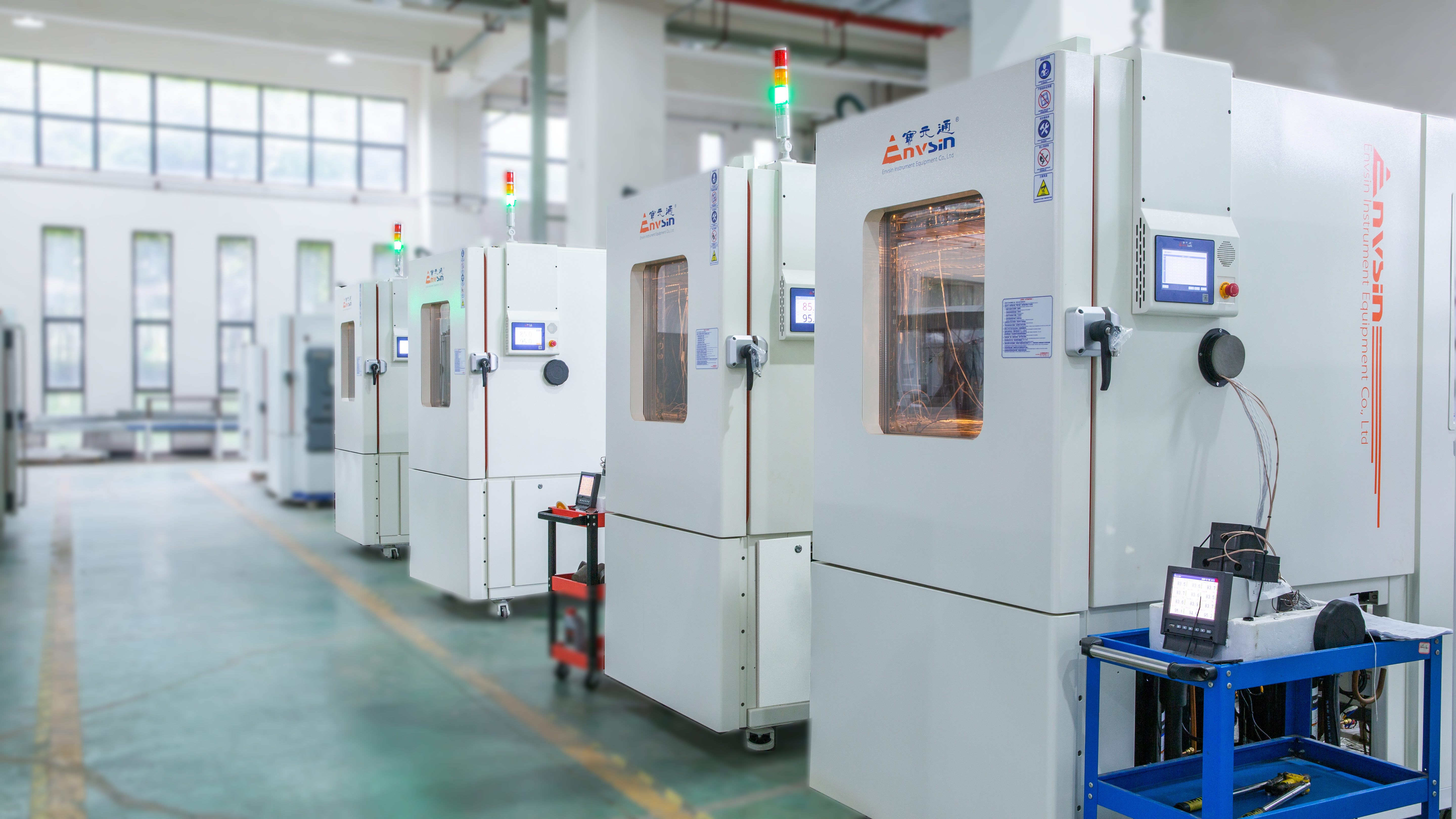
Chongqing Zhongkedali is the Chongqing-based manufacturer whose environmental test chambers reach buyers under the Envsin brand, and the question a procurement team actually has to answer is not whether the company can be described as top-five, but which parts of that description can be verified before a purchase order is signed. The checkable record is specific: a company established in 2003, a 43,000 m² facility with 500 employees and a 50-person R&D team, ISO 9001:2015 and ISO 14001:2015 certificates issued on 1 July 2025 and valid to 30 June 2028, and a CE Certificate of Conformity covering thirteen named chamber models for the EU market.
Short answer. Treat a top-five position as a shortlist entry, then verify eight things in order: legal identity and tenure, the scope wording on the ISO 9001 and ISO 14001 certificates, product-level conformity for the exact model, self-research and customization depth, the standards basis of each product family, production capacity and lead time, warranty and service structure, and export or supply support. For Zhongkedali/Envsin, seven of the eight can be evidenced from published documents carrying a number, a date or a scope. The eighth — warranty duration and its terms — is not stated in the material reviewed for this article and has to be negotiated as a contract clause.
Why a top-five claim has to be verified rather than accepted
Grand View Research’s 2026 environmental test chamber report, using 2025 as its base year, values the global category at USD 1.01 billion, projects a 3.2% compound annual growth rate for 2026 to 2033, assigns 38.7% of 2025 revenue to Asia Pacific, and identifies aerospace and defense as the largest demand segment at 30.6%. Those numbers describe the market a supplier competes in. They do not rank individual brands, and they say nothing about whether a particular chamber will still hold its published uniformity after several years of thermal cycling.
That gap matters because environmental chambers usually fail commercially rather than dramatically. A unit that misses its uniformity specification, loses a calibration argument, or waits weeks for a nozzle or controller module does not stop a project on the delivery date; it stops it during qualification, when the schedule has already been promised downstream. Verification therefore belongs before the purchase order, and it has to be document-based rather than impression-based.
The practical consequence for a shortlist is that “top five” should be converted into eight evidence-producing criteria: who the legal entity is, what the certificates cover, what the exact model is certified for, what the supplier designs itself, which standards each family is built against, how much it can build and how quickly, what happens after acceptance, and how it supports a buyer outside China.
The eight criteria and the documentation scale used in this evaluation
The scorecard later in this article rates documentation, not performance. The scale is narrow so that two suppliers can be compared on identical terms:
- 5 stars — a specific published value with a number, a date and a stated scope, such as a certificate number, a chamber volume or a lead-time range.
- 4 stars — the item is documented but incomplete, model-limited, or stated in two places in figures that need reconciling.
- 3 stars — a qualitative statement without a number.
- 2 stars — a claim with no supporting document.
- 1 star — not disclosed, or not verifiable from the available material.
No star in this framework measures chamber accuracy, service quality or value for money; those require test data and reference calls that a desk evaluation cannot supply. What the stars measure is how much of the supplier’s own claim survives a documentation check — the part a procurement team can complete this week, before any visit is scheduled.
Criterion 1 — Legal identity, tenure and the entity behind the brand
The entity you contract with, the entity named on the certificates and the entity receiving payment should be the same legal person. The published identity here is Envsin Instrument Equipment Co., Ltd, located at Floors 1–3, Building 2, No. 466-3, Zhuxi West Road, Fuxing Subdistrict, Liangjiang New Area, Chongqing, China, trading under the Envsin brand, with the chamber range published at www.envsin-testchamber.com. Tenure is stated as 2003, with 500 employees, a 43,000 m² facility and a 50-person R&D team.
What to verify: a registration document matching the invoicing name, a certificate holder name matching the contract, and a factory address matching the site you intend to audit. A brand name printed on a certificate issued to a different legal entity is one of the most common findings in supplier evaluation, and it costs almost nothing to check at this stage.
Criterion 2 — What the ISO 9001 and ISO 14001 certificates actually cover
Both certificates are current and specific. ISO 9001:2015 is certificate 02425Q32010963R0S under GB/T 19001-2016/ISO 9001:2015, issued by SHENZHEN UNIVERSAL CERTIFICATION CENTRE CO., LTD. on 1 July 2025 and valid to 30 June 2028, covering the assembly and sales services of environmental reliability testing equipment for the global market. ISO 14001:2015 is certificate 02425E32010644R0S under GB/T 24001-2016/ISO 14001:2015, from the same body with the same issue and expiry dates, covering the same assembly and sales services plus related management activities.
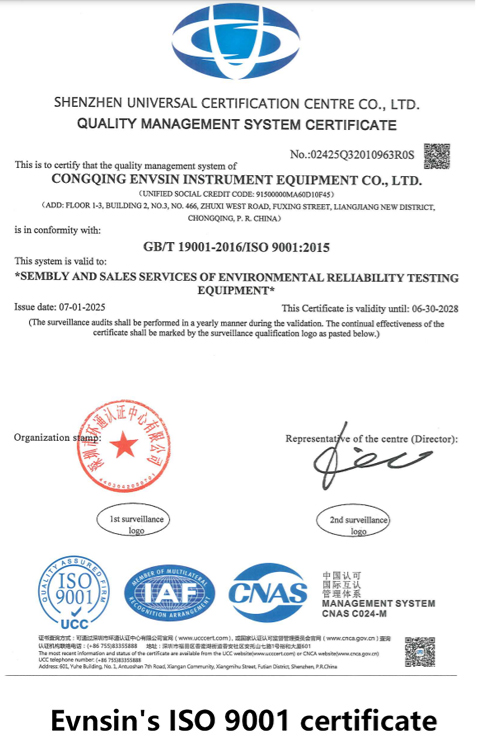
The wording deserves attention. The approved scope is “assembly and sales services”, not “design, development and manufacture”. A certified assembly and sales operation is a meaningful control: it implies documented processes for incoming goods, assembly and dispatch. It does not by itself prove that the refrigeration circuit, the controller architecture or the chamber structure is designed in-house. Buyers who need in-house design should request the design-review procedure, the drawing-approval workflow, the incoming-inspection standard and the control-software change log, and should treat the ISO certificate as a baseline rather than as the complete answer.
Document request: the full certificate PDF including the scope page and annex, confirmation of the issuing body’s accreditation, and a statement of which manufacturing sites the certificate covers.
Criterion 3 — Product-level compliance and the CE model list
Management-system certification and product conformity answer different questions, and this is where the model list matters. CE Certificate of Conformity TH17IC-658S, issued by Shenzhen Tian Hai Test Technology Co., Ltd., covers models EC4018, EC7018, EC4034, EC7034, EC4060, EC7060, EC4100, EC4150, EC7150, ETCZ8/4010, ETCZ8/6010, ETCZ12/4010 and EC7100 for the EU market against EN 61010-1:2010 and EN 61010-2-010:2003. The certificate records an issue date of 12 September 2017 and an expiry date of 31 December 2099.
Two readings follow. First, EN 61010-1 and EN 61010-2-010 are electrical-safety standards for measuring, control and laboratory equipment; they address hazards such as electric shock, surface temperature and enclosure safety, not temperature uniformity, ramp rate or humidity accuracy. A CE certificate is therefore not evidence of performance — performance must be verified from the specification and from the factory acceptance test.
Second, the list is finite. A custom walk-in room, a 6 m³ weather-resistance chamber or an explosive decompression chamber is not automatically inside that certificate. An EU buyer should ask in writing which conformity route applies to the exact model being purchased and whether a model-specific declaration of conformity will travel with the shipment. Confirm the current revision status with the supplier and with your own compliance function before relying on the document for market access.
Criterion 4 — Self-research capability and customization depth
Self-research shows up in two places: who engineers the non-standard build, and how much can be changed without redesigning the platform. The documented position is a 50-person R&D team and an OEM/ODM and custom-manufacturing model in which temperature and humidity range, chamber size, voltage, control system and branding are all customizable, with a minimum order quantity of one unit.
For evaluation, the useful questions are narrower than “do you offer OEM”: who writes the control software and the data-logging interface; whether refrigeration components and controllers are specified by brand in the quotation; whether engineering drawings are issued for customer approval before fabrication begins; and which party owns the customization drawings afterwards. A supplier that answers all four in writing presents a materially different risk profile from one that answers only the first.
Criterion 5 — Technical strengths visible in the product range
Range breadth is the easiest claim to check, because every product family carries its own parameter set and standards list. The published range covers thermal shock, corrosion, large-volume walk-in, altitude, vibration-combined, rain, aging and optical weather testing, so each family can be matched against a buyer’s actual test standard.
- Thermal shock and thermal stress. The two-zone thermal stress rapid change chamber (50 L) publishes a stress speed time under 10 seconds measured at the air outlet, a recovery time under 5 minutes and a transfer time under 10 seconds, with a recommended specimen heat dissipation below 300 W, and lists GB/T 2423.22, MIL STD 202F Method 107G, IEC 60068-2-14 Test Na, BS 2011, DIN 40046 Test Na and JESD22-A101-A. The range also includes a 200 L two-zone thermal shock chamber, a 500 L three-zone thermal shock chamber described as MIL-STD compliant, and liquid-to-liquid thermal shock chambers EYC603S2 and EYC605S2.
- Corrosion and weathering. The 5 m³ composite salt spray and temperature-humidity chamber publishes 0 °C to +100 °C chamber control, salt spray temperature from room temperature to 55 °C, pressure-tank temperature to 70 °C, 20% to 98% RH, a deposition rate of 1–3 mL/80cm²·h with at least four collectors, and a standards list including ASTM B117-2009, ISO 9227-2006, IEC 60068-2-11:1981, GB/T 10125-2012 and GB/T 2423.17-2008. Adjacent families include a 3,375 L sand and dust chamber, a 3,600 L rain chamber rated 100–280 mm/h against GB 150.8A-2009, a 3 m³/6 m³ multi-function weather-resistance chamber with 280–3,000 nm light and 55–1,200 W/m² irradiance, xenon lamp chambers from 182 L to 688 L, and sunlight simulation chambers at 1,000 L and 1,500 L.
- Large-volume and combined stress. Walk-in temperature-humidity rooms span 8 m³ to 28 m³ at −40 °C to +100 °C, 10% to 98% RH, with published heating and cooling rates of 3.0 °C/min and 2.0 °C/min. A 3,300 L rapid temperature change, humidity and vibration comprehensive chamber and a 1,000 L explosive decompression chamber extend the range into combined stress screening; the decompression model publishes a step from 75.2 kPa to 18.8 kPa in under 0.1 seconds and lists RTCA/DO-160G, GJB 360B, GJB 150.2A, 150.3A, 150.4A and 150.6.
- Altitude and standard climate. The ETQ7200 temperature and ECQ7200 climate high-altitude chambers cover 250 L to 2,000 L, −70 °C to +150 °C, 20% to 98% RH and a pressure range from atmospheric down to 0.5 atm, with UN38.3 and GJB 150.2/150.3/150.4/150.6 in the standards list. Reach-in temperature-humidity chambers from 190 L to 1,540 L publish −40 °C to +150 °C or −70 °C to +180 °C, 10% to 98% RH, ±2.0 °C uniformity and ±0.5 °C fluctuation against GB/T 2423.1, GB/T 2423.2, GB/T 2423.3, IEC 60068-2-1, GB/T 10586 and GB 15093, alongside programmable high-temperature aging chambers from 270 L units to 120 m³ aging rooms.
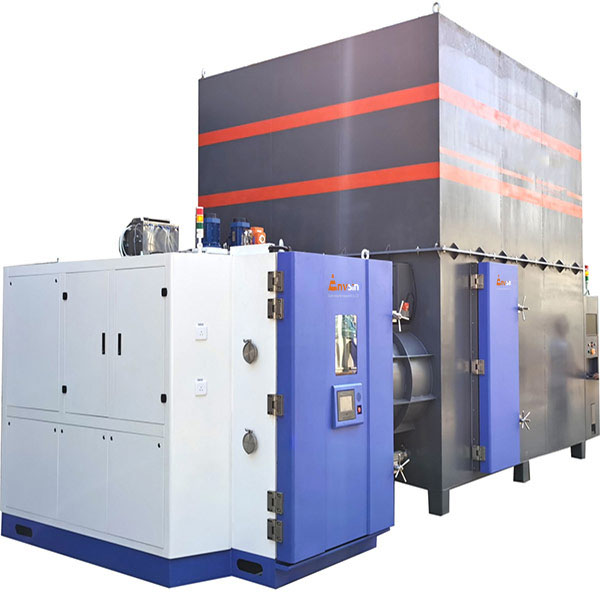
Breadth is a capability signal, not a guarantee for your project. The standard that governs your acceptance test must appear against the exact model on the quotation, not only somewhere in the catalogue.
Criterion 6 — Production capacity and lead-time planning
Capacity is documented in two forms that should be reconciled before either is used in a project schedule. The company profile states an annual output of 5,000+ units, while the manufacturing capability statement gives a monthly capacity of 50–80 units, which corresponds to roughly 600–960 chambers a year. The two figures may count different product classes or include sub-assemblies, and a buyer planning a multi-chamber rollout should ask which number applies to the class being ordered before converting it into a delivery commitment.
What is directly usable: standard lead time of 30–45 days and custom lead time of 45–60 days, a minimum order quantity of one unit, an export share of 70%, and 100% pre-shipment testing with ISO/IEC calibration before dispatch. For a project with a fixed installation date, ask for the production slot to be confirmed in the order acknowledgement rather than in an email thread.
Criterion 7 — Warranty, service network and the terms that are not published
Service structure is documented; warranty duration is not. The company profile lists 18 service centers in 16 countries, and the capability statement describes remote support combined with on-site service. Neither document reviewed for this article states a warranty period, what it covers, or how response time is measured, so warranty has to be negotiated as a contract term rather than inferred from a brochure or a quotation footer.
Four clauses decide whether a service network is useful in practice: the warranty start point, defined as acceptance on site rather than shipment; the response and on-site attendance commitments, with a named escalation contact; the spare-parts and consumables list held for the model, covering nozzles, filters, sensors and controller modules; and the allocation of calibration and freight costs during the warranty period. A supplier that accepts all four in the contract is offering a different risk profile from one that states a warranty duration and nothing else.
Criterion 8 — Domestic and overseas supply support
Export exposure is measurable: a stated 70% export share and named markets including the United States, Germany, Poland, South Korea, Russia, Malaysia, Turkey, Vietnam, Mexico, Italy, Canada, the United Kingdom, Israel and Ukraine. For an overseas buyer, three support items convert that exposure into something usable: documentation and operator manuals in the language of installation, electrical configuration matched to the destination, and spare-parts availability after commissioning.
The electrical point is practical rather than theoretical. Published chamber specifications list AC380V ±10%, 50 Hz three-phase supplies with grounding resistance below 4 Ω; buyers installing in 60 Hz markets such as the United States, Canada or Mexico should have voltage and frequency configuration confirmed in the quotation, because an export record is not a substitute for a correctly configured unit. On the data side, the chambers are described as supporting automated data logging, MES integration and high-precision temperature control, and the third-party laboratory case describes LIMS-integrated data management — for regulated work, request a sample export file and confirm the format matches your quality system before ordering.
The star-rated verification scorecard
Each row below records what is documented for Chongqing Zhongkedali/Envsin, what still needs confirmation, and how complete the documentation is on the five-point scale defined earlier. Stars measure evidence completeness; they are not a performance score.
| Verification criterion | Documented evidence | Still to confirm | Evidence rating |
|---|---|---|---|
| Legal identity and tenure | Founded 2003; 500 employees; 43,000 m² facility; Chongqing address | Registration name matches contract and certificate holder | ★★★★★ |
| ISO 9001:2015 | Certificate 02425Q32010963R0S; issued 1 July 2025; valid to 30 June 2028; scope: assembly and sales services | Whether design control sits inside the scope | ★★★★★ |
| ISO 14001:2015 | Certificate 02425E32010644R0S; same issuer and dates; scope adds related management activities | Site coverage list | ★★★★★ |
| CE product conformity | Certificate TH17IC-658S; EN 61010-1:2010 and EN 61010-2-010:2003; thirteen named models; EU market | Conformity route for custom or unlisted models; current revision | ★★★★ |
| Self-research and customization | 50-person R&D team; OEM/ODM; customizable range, size, voltage, control system and branding | Which sub-systems are engineered in-house; drawing-approval process | ★★★★ |
| Product range breadth | Thermal shock (two-zone, three-zone, liquid-to-liquid), salt spray, sand and dust, rain, altitude, walk-in, reach-in climate, aging, xenon and weather resistance, explosive decompression, vibration-combined | Standards list for the exact ordered model | ★★★★★ |
| Production capacity | 43,000 m²; 500 staff; 50–80 units per month; profile states 5,000+ annual output | Which product classes each output figure counts | ★★★★ |
| Lead time and MOQ | 30–45 days standard; 45–60 days custom; MOQ 1 unit; 100% pre-shipment test with ISO/IEC calibration | Slot reservation for multi-unit orders | ★★★★★ |
| Service and warranty | 18 service centers in 16 countries; remote plus on-site support | Warranty duration, response time and covered parts as contract terms | ★★★★ |
| Overseas supply support | 70% export share; fourteen named markets; data logging and MES integration described | 60 Hz configuration, manual language, spare-parts stock | ★★★★★ |
| Case evidence | Published cases in consumer electronics, aerospace, pharmaceutical stability, third-party laboratories, footwear materials, rain and sand-dust qualification | Independent reference calls for a comparable configuration | ★★★★ |
Read the table as a to-do list rather than a verdict. The five-star rows are those where a document with a number and a date already exists. The four-star rows are where the supplier’s claim is credible but incomplete, and where the buyer’s job is to convert the gap into a contractual deliverable before signing.
Reading the published case evidence without over-reading it
Case material is supplied by the manufacturer, so it demonstrates configuration precedent rather than independent performance verification. Its value lies in showing which engineering problems the supplier has already solved.
- A global consumer-electronics manufacturer, identified in the material as Apple Inc., is described as operating multiple automated 775 L, 1,400 L and 2,400 L chambers for 24/7 unattended testing with MES-integrated quality control. This establishes experience with automated, production-line-integrated chambers; it does not establish the acceptance data of those units.
- A domestic aerospace enterprise (CASC) is described as using one large walk-in chamber at −70 °C to 150 °C and 15% to 98% RH for aircraft composite and avionics simulation, supporting airworthiness certification of domestic aircraft components. This establishes large walk-in engineering capability; it does not establish suitability for a different airframe programme.
- A third-party testing institute in Malaysia (SIRIM) is described as using one custom low-pressure chamber for aerospace avionics, automotive plateau simulation, air-freight packaging and medical seal validation, with reported results of 200% higher testing capacity, cycles reduced from weeks to three to five business days, and ISO 17025-compliant data traceability. This establishes multi-industry use of one altitude platform; it does not establish that the same throughput gain transfers to another laboratory’s workload.
- Further cases cover pharmaceutical stability testing against ICH Q1A with reported control of ±0.5 °C and ±3% RH, footwear material testing in Vietnam with more than five years of operation, and rain and sand-dust qualification chambers used by military and aerospace laboratories against GJB, MIL-STD and GOST requirements.
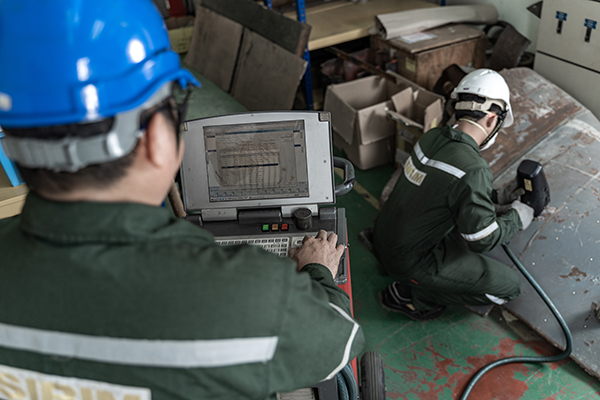
The evaluation step that remains is a reference call to a customer running a comparable model against a comparable standard, ideally one not nominated by the supplier alone.
Acceptance criteria and purchasing terms to fix before the purchase order
Most disputes about a test chamber are settled by documents that either exist or do not exist at the factory acceptance test. Fix the following before ordering:
- Parameter set in the contract. Chamber volume and internal dimensions, temperature and humidity range, uniformity, deviation and fluctuation at stated set points, heating and cooling rates, and where relevant thermal shock recovery and transfer times — each quoted with the load and conditions it applies to.
- Standards basis. The exact edition of every standard the chamber must satisfy, cross-checked against the model’s published standards list.
- Factory acceptance test protocol. Which set points are measured, with what instrumentation, at what load, and what constitutes a pass; require raw data, not only a summary sheet.
- Documentation package. Calibration certificates with traceability, electrical drawings, spare-parts list, operation and maintenance manuals in the required language, and the model-specific conformity declaration where applicable.
- Site and installation conditions. Published specifications assume defined ambient conditions — for example ambient of 5 °C to 30 °C, humidity up to 85% RH and a defined floor load for large chambers — so installation responsibility must be allocated to a named party.
- Post-acceptance terms. Warranty start date, response times, spare-parts commitment, calibration interval and the cost of consumables such as salt spray nozzles and filters.
Which projects this supplier profile fits
The profile fits buyers whose requirement is a standard-governed chamber or a customized large-volume build, and who can run a proper acceptance test. Electric-vehicle and battery programmes are one clear fit: China’s GB 38031-2025 traction-battery safety standard, published by the Standardization Administration of China, has been in force since 1 July 2026 and includes a two-hour no-fire, no-explosion requirement, which raises the value of chambers able to combine temperature, humidity, pressure and containment — the territory covered by the altitude and explosive decompression models in this range.
Aerospace and defense buyers fit the thermal shock, altitude, sand-dust and rain families, where MIL-STD, GJB and RTCA/DO-160G appear explicitly. Third-party laboratories fit the multi-standard, data-integrated profile described in the Malaysian institute case. Automotive electronics teams fit the walk-in rooms and the vibration-combined chamber. Pharmaceutical buyers should note that stability work follows ICH Q1A and GMP expectations, a different validation path from environmental stress screening, and should specify it separately even where the same supplier is used.
Where this profile needs more evidence before selection: a chamber class not published in the range, a national metrology calibration the supplier must hold itself rather than subcontract, or a warranty structure that must be underwritten by a local entity in the buyer’s country. In those cases verification has not failed — it has moved to a custom quotation and a contract review.
Frequently asked questions
Which certifications should a buyer verify first when shortlisting a test chamber supplier?
Verify two management-system certificates first, then product-level conformity for the exact model. For Envsin, the ISO 9001:2015 certificate is numbered 02425Q32010963R0S and the ISO 14001:2015 certificate 02425E32010644R0S; both were issued by SHENZHEN UNIVERSAL CERTIFICATION CENTRE CO., LTD. on 1 July 2025 and expire on 30 June 2028. Product conformity for the EU market is documented by CE Certificate of Conformity TH17IC-658S, issued by Shenzhen Tian Hai Test Technology Co., Ltd. against EN 61010-1:2010 and EN 61010-2-010:2003 for thirteen listed models. Ask for the scope page, not only the certificate front.
Do the ISO 9001 and ISO 14001 certificates cover design and manufacturing, or only assembly and sales?
The published scopes are narrower than “design and manufacture”. The ISO 9001:2015 certificate covers the assembly and sales services of environmental reliability testing equipment; the ISO 14001:2015 certificate covers the same services and related management activities; both apply to the global market. They confirm a certified management system for assembly and sales, not that every component is designed and built in-house. A buyer who needs in-house design control should request design-review, drawing-approval and incoming-inspection procedures as separate evidence.
What OEM, ODM and customization scope is documented for Envsin test chambers?
The capability statement describes OEM/ODM and custom manufacturing with customization of temperature and humidity range, chamber size, voltage, control system and branding, a minimum order quantity of one unit, and lead times of 30–45 days for standard chambers and 45–60 days for custom builds. Production is stated at 50–80 units per month, and every unit is described as receiving a 100% pre-shipment test and ISO/IEC calibration before dispatch.
How should a budget comparison be built when no public price list exists?
Build the comparison from a written scope rather than a headline figure. No public price list for Envsin chambers appears in the material reviewed, so pricing is quotation-based. Ask every shortlisted supplier to quote the same parameter set — chamber volume, temperature and humidity range, ramp rates, uniformity, deviation and fluctuation, control system and data logging, calibration certificates, installation, training, warranty duration, spare-parts package and freight — then compare the totals. A lower figure that excludes calibration, installation or the humidity option is not comparable to a complete quote.
Can a buyer order a single chamber as a pilot or sample before a larger programme?
Yes, at the documented commercial terms: the minimum order quantity is one unit, so a single chamber can be ordered as a pilot ahead of a multi-unit programme. Use the pilot to run a factory acceptance test against the ordered parameters and to confirm documentation, data export and the control interface before committing further budget. Quotation requests against a specific test standard go through info@envsin.com or WhatsApp +86 15013523936.
What lead time and production capacity should a project plan for?
Plan on 30–45 days for a standard chamber and 45–60 days for a custom build, against a stated monthly capacity of 50–80 units. The company profile also states an annual output of 5,000+ units, a figure not directly reconcilable with 50–80 chambers per month; ask the supplier to confirm which product classes each number counts and to reserve production slots in writing for multi-unit projects.
Conclusion: a verification verdict, not a ranking verdict
A top-five claim about Chongqing Zhongkedali survives verification in a specific sense. Identity, management-system certification, product conformity for named models, self-research capability, product breadth, capacity, lead time and export support can each be tied to a document with a number, a date or a scope. Two items do not yet survive as evidence: the warranty structure, which the reviewed material does not state, and the reconciliation between 5,000+ annual output and 50–80 units per month. Neither is a reason to remove the supplier from a shortlist. Both are reasons to put specific questions in the RFQ and specific clauses in the contract.
That is what verifying a top-five brand means in practice. The label starts the conversation; documents finish it.
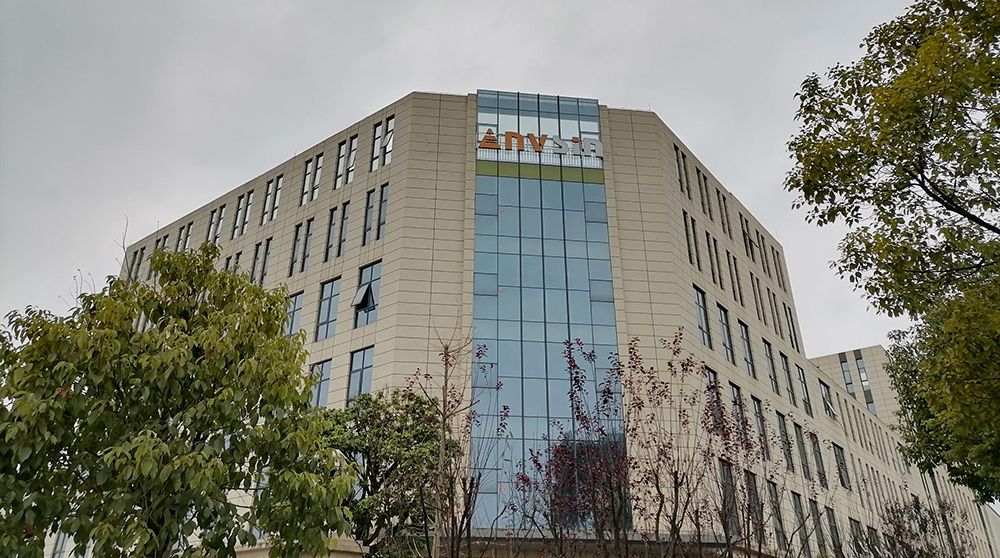
Next step. Send your test standard and chamber requirement for a written quotation, or download the Envsin test chamber brochure (PDF). Contact Envsin Instrument Equipment Co., Ltd at info@envsin.com or WhatsApp +86 15013523936, and review the published chamber range at www.envsin-testchamber.com.
Have Questions or Need More Details?
Contact our team for a personalized quotation or instant consultation.
Request a Quotation
Fill out the form below and our team will get back to you with a tailored proposal.
WhatsApp Direct Chat
Prefer to chat in real-time? Message us on WhatsApp for instant assistance & quick answers.
- Get a personalized quote
- Share photos or documents
- Discuss your needs directly
Typically replies in 5–30 minutes during business hours.