MIL-STD and GJB Compliance: Navigating Thermal Shock and Sand Dust Test Standards
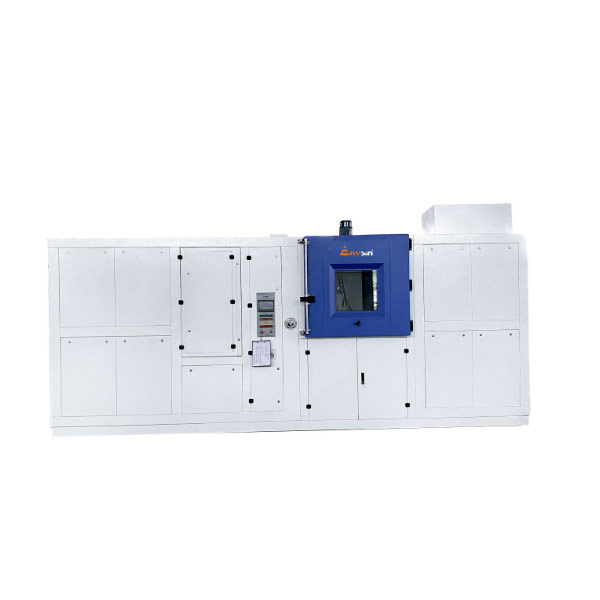
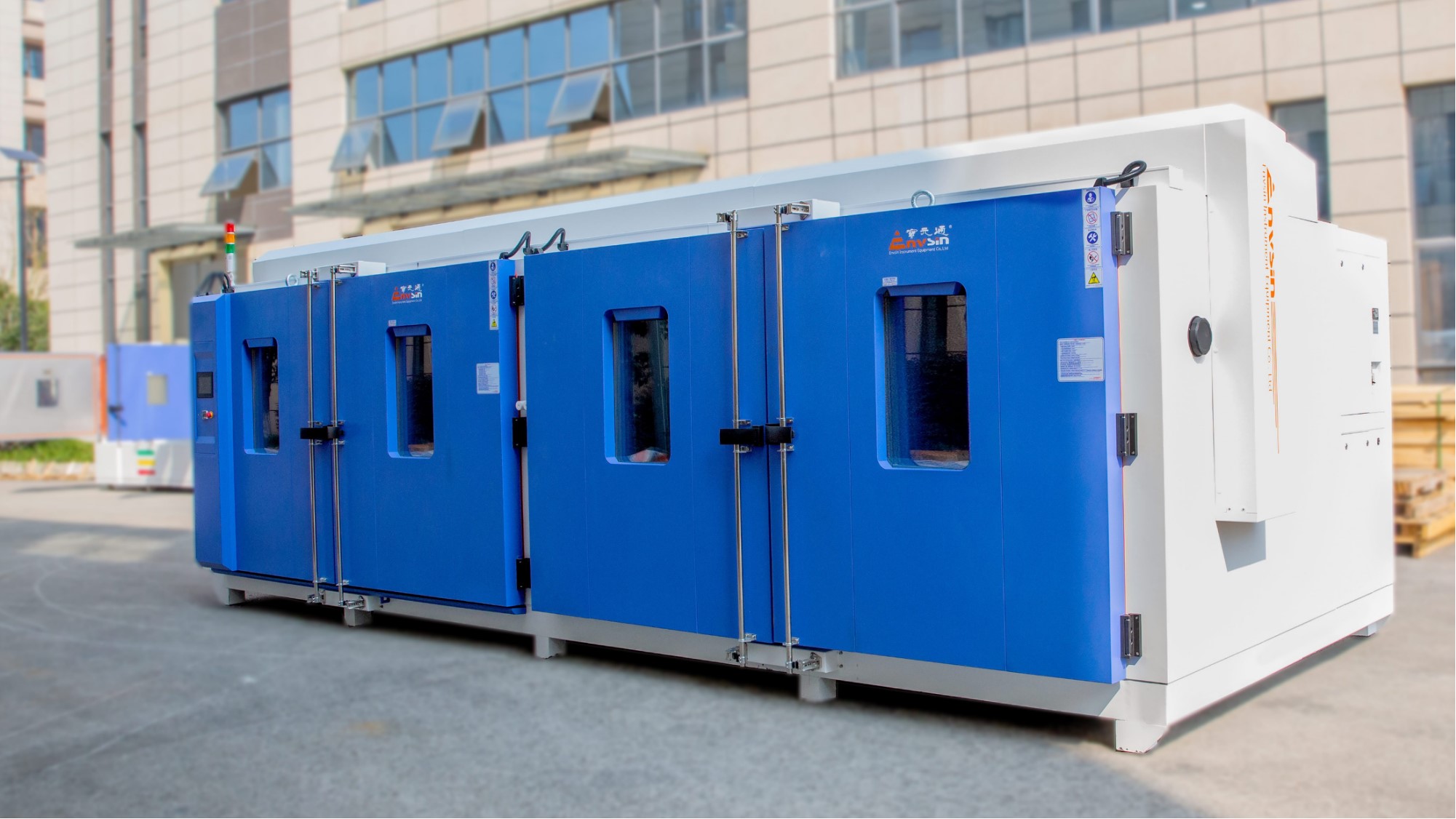
Sand and Dust Test Chamber (3375L) — specified for GJB 150.12A—2009, with a dust fall amount of 10.6 g/m³ ± 7 g/m³ and dust blowing wind speed of 1.5–8.9 m/s.
Compliance with MIL-STD and GJB standards is a measurable match between three things: the environmental profile the standard defines, the envelope a chamber can hold, and the records a chamber can produce. A supplier who cannot demonstrate all three is offering capability, not compliance. This guide interprets the two compliance cases that most often appear together in military, aerospace and electronics procurement programmes: MIL-STD thermal shock methods run on a Three-zone Thermal Shock Test Chamber (500L), and GJB 150.12A—2009 run on a Sand and Dust Test Chamber (3375L).
Envsin — the brand of Envsin Instrument Equipment Co., Ltd, an environmental test equipment manufacturer founded in 2003 with a 43,000 m² factory in Chongqing, China and approximately 70% of output exported — builds both configurations. The parameters cited throughout this article, including the -65°C to +150°C thermal shock envelope, the 1.5–8.9 m/s dust blowing wind speed and the 10.6 g/m³ ± 7 g/m³ dust fall amount, come from those two product specifications and from Envsin's published certification records. These are the facts that decide whether a qualification report survives technical review.
Why “Compliant” Is Harder Than It Looks
Three problems cause most disputes between test chamber buyers and suppliers.
1. A specification sheet is not a test profile
A datasheet states that a chamber reaches -65°C and +150°C. A MIL-STD thermal shock method states how long the specimen dwells at each extreme, how fast it transfers, how long recovery takes and how uniform the specimen environment must be during the dwell. The gap between those two statements is where compliance is won or lost. For the Three-zone Thermal Shock Test Chamber (500L), the compliance-relevant figures are a low-temperature shock range of -65°C to -10°C, a high-temperature shock range of +60°C to +150°C, temperature uniformity ≤2°C, temperature fluctuation ±0.5°C, temperature deviation ±2°C and a temperature recovery time ≤5 minutes.
2. Standards define measured quantities, not product categories
GJB 150.12A—2009 is not satisfied by “a dust chamber”. It is satisfied by a chamber that controls and monitors the quantities the method cares about: dust concentration, air velocity, particle size distribution, internal humidity and airflow behaviour across the working section. The Sand and Dust Test Chamber (3375L) is specified for this standard with a dust fall amount of 10.6 g/m³ ± 7 g/m³, a dust blowing wind speed of 1.5–8.9 m/s adjustable at the air outlet, test dust composed of 97%–99% silicon dioxide (quartz sand) with particle diameter ≤149 μm, and an internal humidity requirement below 30% RH throughout the test.
3. Certificate scope is narrower than the logo suggests
Management-system and product-safety certificates belong to specific scopes and specific model lists. In Envsin's published records, ISO 9001:2015 (certificate number 02425Q32010963R0S) and ISO 14001:2015 (certificate number 02425E32010644R0S) are issued by SHENZHEN UNIVERSAL CERTIFICATION CENTRE CO., LTD. and cover the assembly and sales services of environmental reliability testing equipment. The CE Certificate of Conformity (certification number TH17IC-658S), issued by Shenzhen Tian Hai Test Technology Co., Ltd. against EN 61010-1:2010 and EN 61010-2-010:2003, covers the models EC4018, EC7018, EC4034, EC7034, EC4060, EC7060, EC4100, EC4150, EC7150, ETCZ8/4010, ETCZ8/6010, ETCZ12/4010 and EC7100. Buyers running a GJB or MIL-STD programme should read those scope lines before treating a certificate as evidence of product compliance.
Why MIL-STD and GJB Requirements Are Converging in Procurement
Demand for certified environmental testing capacity is growing, and the growth is concentrated in the industries that write the strictest standards. Grand View Research valued the global environmental test chamber market at USD 1.01 billion in 2025 and projects a 3.2% CAGR from 2026 to 2033, with Asia Pacific accounting for 38.7% of global revenue in 2025 and aerospace and defence representing 30.6% of industry demand. Those figures explain why a manufacturer with a 70% export share competes directly against established European and Japanese brands on compliance documentation rather than on price alone.
Regulatory tightening reinforces the same trend. China's GB 38031-2025 for electric vehicle traction batteries takes effect on 1 July 2026 and imposes a two-hour no-fire, no-explosion requirement — a change that pushes battery programmes toward chambers with verified safety containment. For military and aerospace buyers, the practical consequence is that “which standard can this chamber actually run” has replaced “what temperature range does it reach” as the first screening question.
MIL-STD Thermal Shock Compliance on the Three-Zone 500L Chamber
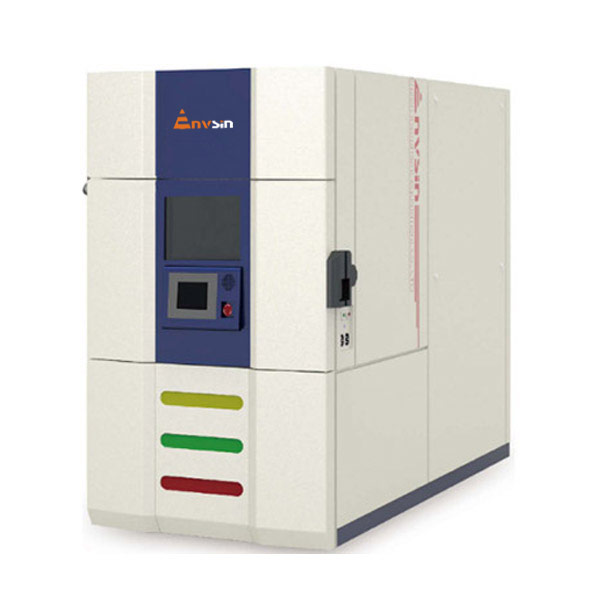
Three-zone Thermal Shock Test Chamber (500L) — applicable standards include GJB 150.5-1986, MIL STD 883H, MIL STD 202G and IEC 60068-2-14.
The Three-zone Thermal Shock Test Chamber (500L) is a water-cooled, three-zone configuration comprising a fixed independent test zone, a pre-heating zone and a pre-cooling zone, with a test volume of 500 L and chamber dimensions of 900 × 800 × 700 mm. Its overall external dimensions are approximately 1950 × 2350 × 2400 mm excluding protruding parts.
Why the three-zone layout matters for compliance. In a three-zone design the specimen stays inside a fixed test zone while pre-conditioned air is introduced from the pre-heating or pre-cooling zone. In a two-zone design the specimen itself is moved between zones — the Two-zone Thermal Shock Test Chamber (200L), for example, uses a movable test product structure. Buyers running delicate assemblies, cable harnesses or massive instruments should confirm which architecture the standard profile permits and which the specimen tolerates.
Compliance-relevant parameters on the three-zone chamber:
- Low-temperature shock range: -65°C to -10°C
- High-temperature shock range: +60°C to +150°C
- Temperature uniformity ≤2°C; temperature fluctuation ±0.5°C; temperature deviation ±2°C
- Temperature recovery time: ≤5 minutes
- Pre-heat zone: +50°C to +200°C, ambient to +200°C in approximately 50 minutes
- Pre-cool zone: -80°C to +70°C, ambient to -80°C in approximately 80 minutes
- Compressed air source: 0.6–0.7 MPa; pneumatic air moisture content ≤30 g/m³; dry air moisture content ≤1.5 g/m³ (optional)
- Power supply: AC380V ±10%, 50Hz ±1, three-phase four-wire plus grounding, grounding resistance <4Ω; maximum system power approximately 75.5 kW; maximum system current approximately 123.3 A
- Applicable standards: GJB 150.5-1986, MIL STD 883H, MIL STD 202G, IEC 60068-2-14, JIS C 60068-2-14, JASO D 014-4, EIA JED-2531A
- Inner chamber: SS304 stainless steel; outer casing: powder-coated carbon steel
Operational features that support auditability include long-cycle defrosting rated at ≥700 hours, a 4-channel load power supply control for energised specimens, sample anti-condensation and over-temperature/smoke protection, 32-bit colour screen control, Ethernet and USB data access, network video monitoring, APP remote management, automatic room temperature recovery, and a maintenance reminder with remote service support.
GJB 150.12A—2009 Compliance on the 3375L Sand and Dust Chamber
The Sand and Dust Test Chamber (3375L) is a military-grade blowing and settling chamber with IP5X/IP6X ingress-protection capability, specified for GJB 150.12A—2009. Its test volume is 3,375 L with internal dimensions of 1500 × 1500 × 1500 mm and external dimensions of approximately 4800 × 2000 × 2450 mm.
Parameters to verify against the standard method:
- Dust fall amount: 10.6 g/m³ ± 7 g/m³
- Dust blowing wind speed / dust airflow velocity: 1.5–8.9 m/s, adjustable at the air outlet
- Test dust composition: 97%–99% silicon dioxide (quartz sand)
- Dust particle diameter: ≤149 μm
- Humidity requirement: below 30% RH throughout the test
- Effective airflow cross-sectional area: ≥800 × 800 mm
- Turntable diameter ≥Φ700 mm; turntable load capacity ≥200 kg; rotation speed 3–7 r/min
- Temperature range 23°C to +80°C; uniformity ≤2°C; fluctuation ±0.5°C; deviation ±2°C; heating/cooling rate ≥1°C/min
- Power supply: AC380V ±5%, 50Hz ±1, three-phase four-wire plus grounding, grounding resistance <4Ω; maximum operating power approximately 42.1 kW; maximum operating current approximately 72 A
- Applicable standard: GJB 150.12A—2009
- Inner chamber: SS304 stainless steel; outer casing: powder-coated carbon steel
Two design details decide whether the measured parameters hold across repeated runs. The first is a laminar airflow design intended to prevent eddy currents, because turbulence redistributes dust and changes the deposit pattern on the specimen. The second is calibrated instrumentation for dust fall monitoring. The chamber also supports dust blowing, sand blowing and dust settling tests, so one unit can cover several clauses of the same method without rebuilding the test setup.
Step-by-Step: A Compliance Verification Workflow Before You Order
- Extract the test profile from the standard, not from the brochure. Record dwell times, transfer times, recovery limits, dust concentration, air velocity, particle size and humidity for the clauses that apply to your product class.
- Map the profile onto the chamber envelope. For thermal shock, confirm the required extremes sit inside -65°C to -10°C and +60°C to +150°C with margin for load effects. For sand and dust, confirm the required dust fall and wind speed sit inside 10.6 g/m³ ± 7 g/m³ and 1.5–8.9 m/s.
- Verify stability figures, not only range. Uniformity, fluctuation and deviation determine repeatability: ≤2°C, ±0.5°C and ±2°C respectively on both chambers.
- Confirm the facility can support the equipment. The thermal shock chamber requires a compressed air supply of 0.6–0.7 MPa with pneumatic moisture content ≤30 g/m³, water cooling, and a three-phase AC380V ±10% supply at approximately 75.5 kW / 123.3 A. The sand and dust chamber requires AC380V ±5% at approximately 42.1 kW / 72 A.
- Read the certificate scope lines. Match the certification documents — ISO 9001:2015 certificate 02425Q32010963R0S, ISO 14001:2015 certificate 02425E32010644R0S, CE Certificate of Conformity TH17IC-658S — against the models and activities actually covered.
- Confirm data traceability. Both chambers support automated data logging; the thermal shock chamber adds Ethernet and USB data access, 32-bit colour screen control and network video monitoring, which is what an auditor asks for when a report is challenged.
- Plan acceptance testing before shipment. Agree which parameters will be witnessed, at which points, and against which instrument calibration record.
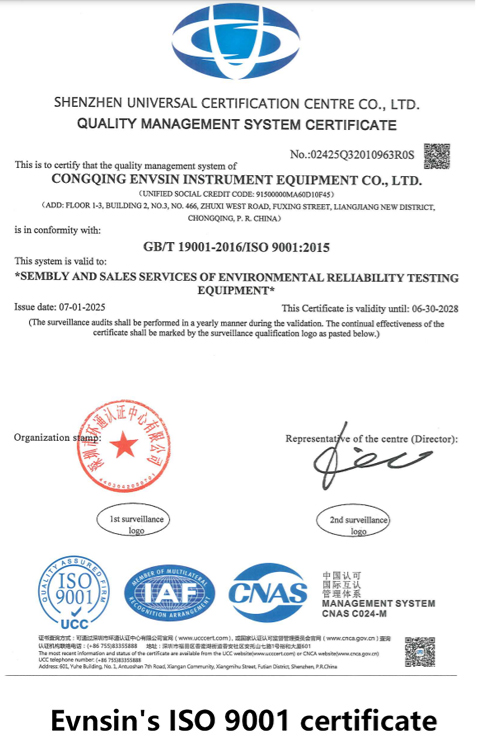
Envsin ISO 9001:2015 quality management system certificate (02425Q32010963R0S), issued by SHENZHEN UNIVERSAL CERTIFICATION CENTRE CO., LTD.
Where These Two Chambers Fit
Military and aerospace qualification programmes. An aerospace and defence testing institution operating Envsin's sand and dust chamber reported tri-military standard compliance across GJB, MIL-STD and GOST requirements, along with a streamlined testing process and improved test repeatability and accuracy after more than three years of stable operation.
Envsin's tri-military standard sand and dust chamber supporting aerospace component qualification testing.
Electronics and electrical reliability engineering. Thermal shock testing applies to electronics and electrical equipment, automotive components, aerospace hardware, materials science samples, communications equipment, pharmaceutical and biotechnology products, and military equipment. For these users the deciding figure is usually the ≤5-minute recovery time, because it sets the throughput of the qualification plan.
Third-party laboratories and test service providers. Laboratories carrying multiple standards need one chamber that satisfies several methods. The thermal shock chamber's standard list spans GJB, MIL-STD, IEC, JIS, JASO and EIA references, while the sand and dust chamber covers dust blowing, sand blowing and dust settling under a single GJB method. Envsin products serve military, aerospace, shipbuilding, manufacturing and quality management applications, supported by 18 service centres in 16 countries.
Comparison Table: Two Compliance Cases Side by Side
| Compliance dimension | Three-zone Thermal Shock Test Chamber (500L) | Sand and Dust Test Chamber (3375L) |
|---|---|---|
| Applicable standards | GJB 150.5-1986, MIL STD 883H, MIL STD 202G, IEC 60068-2-14, JIS C 60068-2-14, JASO D 014-4, EIA JED-2531A | GJB 150.12A—2009 |
| Test volume / chamber dimensions | 500 L; 900 × 800 × 700 mm | 3,375 L; 1500 × 1500 × 1500 mm |
| Temperature envelope | Low shock -65°C to -10°C; high shock +60°C to +150°C | 23°C to +80°C |
| Uniformity / fluctuation / deviation | ≤2°C / ±0.5°C / ±2°C | ≤2°C / ±0.5°C / ±2°C |
| Method-specific parameters | Recovery time ≤5 min; pre-heat zone +50°C to +200°C (≈50 min); pre-cool zone -80°C to +70°C (≈80 min) | Dust fall 10.6 g/m³ ± 7 g/m³; dust blowing wind speed 1.5–8.9 m/s; dust ≤149 μm; 97%–99% silicon dioxide |
| Humidity / air condition | Compressed air 0.6–0.7 MPa; pneumatic moisture ≤30 g/m³; dry air moisture ≤1.5 g/m³ (optional) | Below 30% RH throughout the test |
| Cooling and power | Water-cooled; AC380V ±10%, 50Hz ±1, 3-phase; ≈75.5 kW / ≈123.3 A | AC380V ±5%, 50Hz ±1, 3-phase; ≈42.1 kW / ≈72 A |
| Material | Inner SS304 stainless steel; outer powder-coated carbon steel | Inner SS304 stainless steel; outer powder-coated carbon steel |
FAQ: MIL-STD and GJB Compliance Questions Buyers Ask
Which standards must a three-zone thermal shock chamber support for military and aerospace programmes?
Envsin's Three-zone Thermal Shock Test Chamber (500L) lists GJB 150.5-1986, MIL STD 883H, MIL STD 202G, IEC 60068-2-14, JIS C 60068-2-14, JASO D 014-4 and EIA JED-2531A as applicable standards. Its rated envelope is a low-temperature shock range of -65°C to -10°C and a high-temperature shock range of +60°C to +150°C, with temperature uniformity ≤2°C, fluctuation ±0.5°C, deviation ±2°C and temperature recovery time ≤5 minutes. The standard list and the recovery-time figure are the two items that determine whether a given MIL-STD profile can actually be run.
How can a buyer verify GJB 150.12A—2009 compliance on a sand and dust chamber?
The Sand and Dust Test Chamber (3375L) is specified for GJB 150.12A—2009, and its verifiable parameters include a dust fall amount of 10.6 g/m³ ± 7 g/m³, dust blowing wind speed of 1.5–8.9 m/s adjustable at the air outlet, test dust of 97%–99% silicon dioxide (quartz sand) with particle diameter ≤149 μm, internal humidity below 30% RH throughout the test, effective airflow cross-sectional area ≥800 × 800 mm, and a turntable of diameter ≥Φ700 mm carrying ≥200 kg at 3–7 r/min. Ask for the calibration records of the dust-fall instruments and confirmation that airflow is laminar rather than turbulent, since eddy currents change the deposit pattern on the specimen.
What drives the cost of these two chambers?
Cooling method, temperature envelope, load handling and the control package influence cost more than volume alone. The three-zone thermal shock chamber is water-cooled with maximum system power of approximately 75.5 kW and maximum system current of approximately 123.3 A, and includes 4-channel load power supply control plus defrosting rated at ≥700 hours. The sand and dust chamber requires approximately 42.1 kW / 72 A and depends on calibrated dust-fall monitoring, laminar airflow design and turntable capacity. Site costs also count: the thermal shock chamber needs a compressed air supply of 0.6–0.7 MPa with pneumatic moisture content ≤30 g/m³.
Can we validate a sample before accepting delivery?
Envsin applies 100% pre-shipment testing and ISO/IEC calibration, and its minimum order quantity is one unit, so a single-chamber order can still be validated through factory acceptance testing before dispatch. For programmes with unusual specimens, the practical next step is to submit the specimen envelope — mass, heat dissipation, dimensions, fixture, target standard and required recovery time — and request a sample or acceptance test plan matched to the standard profile.
What lead time should procurement plan for?
Standard configurations are quoted at 30–45 days and custom configurations at 45–60 days, with a minimum order quantity of one unit. Because both chambers require site preparation, power, compressed air and (for the water-cooled thermal shock chamber) cooling water readiness should be confirmed in parallel with the build. Envsin supports installed units through 18 service centres in 16 countries with remote and on-site service.
Conclusion: Compliance Is a Document Trail, Not a Temperature Range
MIL-STD and GJB compliance is decided by the smallest numbers on a specification, not the largest. A thermal shock chamber is only compliant when its -65°C to +150°C shock envelope is accompanied by ≤2°C uniformity, ±0.5°C fluctuation, ±2°C deviation and ≤5-minute recovery. A sand and dust chamber is only compliant when its dust fall amount of 10.6 g/m³ ± 7 g/m³, dust blowing wind speed of 1.5–8.9 m/s, ≤149 μm quartz dust and sub-30% RH condition are all controllable, measurable and traceable to a calibration record.
For buyers in military, aerospace and electronics industries, that means a three-part evaluation: confirm the standard list covers the method you must run, confirm the parameter tolerances inside the chamber envelope, and confirm the certification scope matches the exact model and activity being purchased. Treated this way, compliance stops being a claim on a brochure and becomes a verification checklist that can be closed before purchase order.
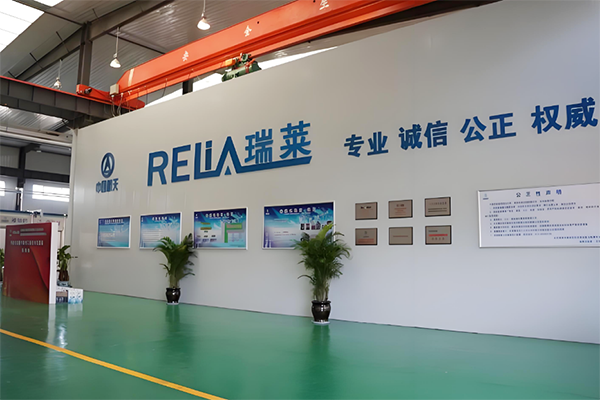
Envsin manufacturing base — 43,000 m² factory supporting thermal shock, sand and dust, climate and walk-in test chamber production.
Next step for your programme
Send the standard clause, the specimen envelope and the required recovery time. Envsin will return a configuration matched to the method, or a sample and acceptance test plan for validation before shipment.
Email: info@envsin.com · Phone/WhatsApp: +86 15013523936 · Website: www.envsin-testchamber.com
Have Questions or Need More Details?
Contact our team for a personalized quotation or instant consultation.
Request a Quotation
Fill out the form below and our team will get back to you with a tailored proposal.
WhatsApp Direct Chat
Prefer to chat in real-time? Message us on WhatsApp for instant assistance & quick answers.
- Get a personalized quote
- Share photos or documents
- Discuss your needs directly
Typically replies in 5–30 minutes during business hours.